Do I Have Insomnia? How to Read Your Insomnia Severity Index (ISI) Score and When to See a Doctor
The ISI is a screening questionnaire. It can show how severe your sleep problems are, but only a qualified clinician can diagnose insomnia or find its cause.
By The Psyche Assess team
What Is Insomnia?
Insomnia means having trouble falling asleep, staying asleep, or waking too early and being unable to get back to sleep, even though you have the chance to sleep, and feeling the effects during the day. Under the DSM-5, insomnia disorder generally requires these problems at least three nights a week. If they last less than three months it’s called short-term (acute) insomnia, and if they last three months or longer it’s chronic insomnia disorder.
It’s very common. Estimates suggest roughly a third of adults report some insomnia symptoms, and around one in ten has a chronic insomnia disorder (Morin & Benca, 2012).
Common Signs and Symptoms of Insomnia
- Lying awake for a long time before falling asleep
- Waking during the night and struggling to get back to sleep
- Waking much earlier than you intended
- Sleep that doesn’t feel refreshing
- Daytime tiredness, irritability, or low mood
- Trouble concentrating or remembering things
- More mistakes or accidents than usual
- Worrying about sleep itself, especially as bedtime approaches
Occasional bad nights are normal. What matters is the pattern: how often it happens, how long it has lasted, and how much it affects your days.
What Is the Insomnia Severity Index (ISI)?
The ISI is a seven-question self-report questionnaire developed by Dr. Charles Morin and colleagues (Bastien et al., 2001). It asks you to rate, on a 0 to 4 scale, how severe your difficulties are with falling asleep, staying asleep, and waking too early. It also asks how satisfied you are with your sleep, how noticeable the problem is to others, how worried or distressed you feel about it, and how much it interferes with daily life. The questions cover the past two weeks, the total score runs from 0 to 28, and it takes about three minutes. It’s widely used in sleep clinics, primary care, and research. You can review the questions and scoring on our Insomnia Severity Index page.
ISI Score Interpretation: What Do the Ranges Mean?
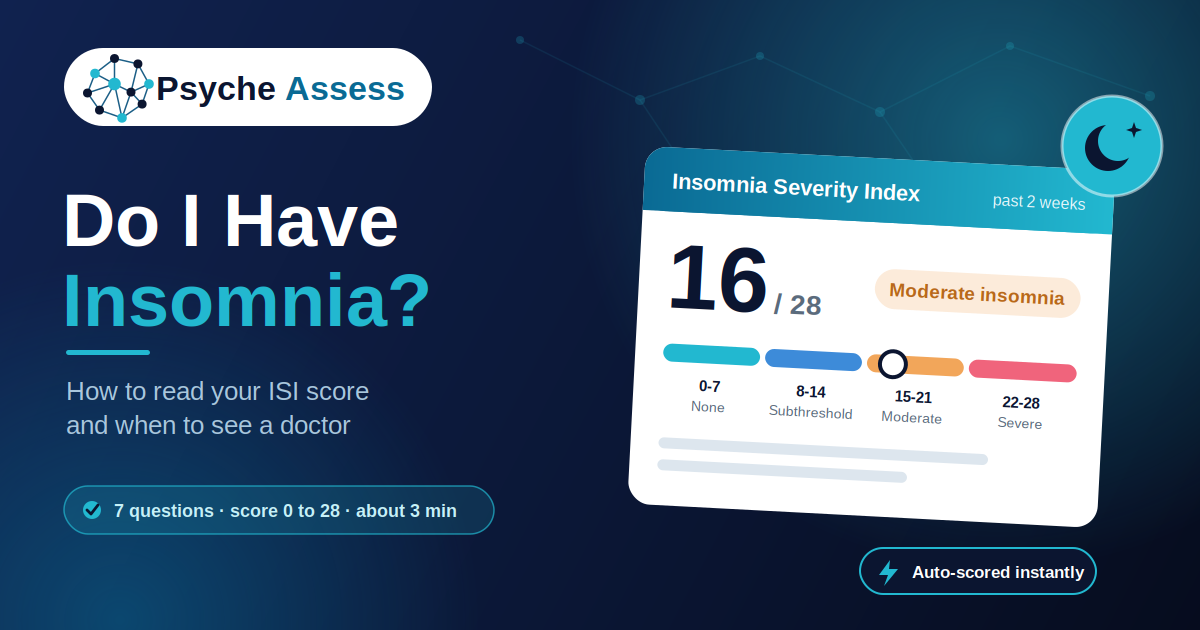
Your total falls into one of four bands:
- 0–7: No clinically significant insomnia. Your sleep difficulties are within the typical range.
- 8–14: Subthreshold insomnia. You have some symptoms. Look at your sleep habits and re-check in a few weeks, and talk to a clinician if it bothers you.
- 15–21: Clinical insomnia, moderate severity. An evaluation by a doctor or sleep specialist is recommended.
- 22–28: Clinical insomnia, severe. See a clinician promptly.
What is the ISI cut-off score of 10?
In a large validation study of community adults, a score of 10 or more was the best threshold for detecting insomnia cases, with a sensitivity of about 86% and a specificity of about 88% (Morin et al., 2011). Many clinics therefore treat 8–14 as a “watch” zone and use 15 or more as the point where clinical insomnia is likely. These are guides, not diagnoses, and your clinician will weigh your score alongside your history and daily functioning.
What the ISI Can and Can’t Tell You
The ISI shows how severe your insomnia symptoms feel. It can’t tell you why you’re sleeping badly, and it doesn’t screen for other sleep disorders such as sleep apnea or restless legs syndrome. It relies on your own perception and covers only the past two weeks. A sleep diary kept for one to two weeks adds useful detail, and a broader measure like the Pittsburgh Sleep Quality Index (PSQI) looks at sleep quality across several components.
Common Causes of Poor Sleep
Insomnia rarely has a single cause. Common contributors include:
- Stress and worry, including work pressure and life changes
- Depression and anxiety, which both disturb sleep and can be worsened by it (screen with the PHQ-9 and GAD-7)
- Irregular schedules, shift work, and jet lag
- Caffeine, nicotine, and alcohol, which can all fragment sleep
- Late-night screen use and bright light, which can delay sleep in some people
- Medical conditions such as chronic pain, reflux, thyroid problems, menopause, sleep apnea, or restless legs
- Medications, including some antidepressants, stimulants, steroids, and decongestants
Persistent exhaustion from work is also worth considering; see our guide to burnout vs. depression.
When to See a Doctor About Insomnia
Book an appointment if any of these apply:
- Sleep problems at least three nights a week for three months, or a shorter spell that is severe
- An ISI score of 15 or higher, or a lower score that clearly affects your life
- Daytime sleepiness that affects work or safety, including drowsiness while driving
- Loud snoring, gasping or choking at night, or someone noticing pauses in your breathing
- A strong urge to move your legs in the evening
- Low mood, hopelessness, or constant worry alongside poor sleep
- Regular use of alcohol or sleep aids to get to sleep
If poor sleep comes with thoughts of harming yourself, get help right away. In the US, call or text 988. In the UK and Ireland, call Samaritans on 116 123. In Australia, call Lifeline on 13 11 14. Elsewhere, contact your local emergency number.
Evidence-Based Treatment for Insomnia
Cognitive behavioral therapy for insomnia (CBT-I) is recommended as the first-line treatment for chronic insomnia in adults (Qaseem et al., 2016). It targets the thoughts and habits that keep insomnia going, and typically includes:
- Stimulus control: training your brain to link the bed with sleep
- Sleep restriction: carefully limiting time in bed, guided by a clinician
- Cognitive techniques: easing unhelpful beliefs and worry about sleep
- Relaxation training and sleep education
CBT-I is available through trained therapists and through some validated digital programs. Medication is sometimes used for short periods, but it carries risks and side effects, so decide on it with your doctor rather than self-treating. A clinician will also look for and treat conditions such as depression, anxiety, or sleep apnea that may be driving the problem.
Simple Steps You Can Try Tonight
These habits help many people with mild or occasional sleep problems. They’re not a substitute for treatment if your insomnia is chronic.
- Keep the same wake-up time every day, including weekends.
- Get daylight soon after waking.
- Avoid caffeine after midday, and limit alcohol close to bedtime.
- Build a calm wind-down routine for 30 to 60 minutes before bed.
- Keep your bedroom cool, dark, and quiet, and use the bed for sleep.
- If you’re awake for a long time, get up and do something calm until you feel sleepy, and avoid watching the clock.
Tracking Your Progress
Retaking the ISI every few weeks shows whether things are improving. In treatment research, a drop of roughly 8 points has been linked to a meaningful improvement, and a score below 8 is often used to define remission (Morin et al., 2011). Bring your scores and a short sleep diary to your appointment so your clinician sees the trend, not just one night.
For Clinicians: Scoring the ISI Accurately
A digital ISI scores each response automatically, applies the four severity bands, and stores results so you can chart a client’s trend across sessions and export it to your EHR. Because insomnia often travels with low mood and anxiety, many clinics run the ISI alongside the PHQ-9 and GAD-7. We compare the approaches in manual scoring vs. automated screening tools, and you can start a free trial to run the ISI in a test practice.
Frequently Asked Questions
Is an ISI score of 12 bad? It falls in the subthreshold range, meaning some insomnia symptoms. It’s worth improving your sleep habits and re-checking, and seeing a clinician if it bothers you.
Can the ISI diagnose insomnia? No. It measures severity. A diagnosis needs a clinical assessment.
When does insomnia become chronic? When it occurs at least three nights a week for three months or longer.
Is insomnia a mental health condition? It’s classified as a sleep-wake disorder in the DSM-5 and often occurs together with anxiety and depression, so treating one can help the other.
The Bottom Line
If you keep asking yourself whether you have insomnia, the ISI gives you a quick, structured answer about how severe your symptoms are. A score of 15 or higher, symptoms lasting three months, or any safety concern is a good reason to see a doctor. The good news is that insomnia is treatable, and CBT-I works for many people without medication.
This article is for general information and isn’t medical advice or a diagnosis.
Sources
- Bastien CH, Vallières A, Morin CM. Validation of the Insomnia Severity Index as an outcome measure for insomnia research. Sleep Med. 2001;2(4):297–307.
- Morin CM, Belleville G, Bélanger L, Ivers H. The Insomnia Severity Index: psychometric indicators to detect insomnia cases and evaluate treatment response. Sleep. 2011;34(5):601–608.
- Qaseem A, Kansagara D, Forciea MA, et al. Management of chronic insomnia disorder in adults: a clinical practice guideline from the American College of Physicians. Ann Intern Med. 2016;165(2):125–133.
- Morin CM, Benca R. Chronic insomnia. Lancet. 2012;379(9821):1129–1141.
- American Psychiatric Association. Diagnostic and Statistical Manual of Mental Disorders, 5th ed. 2013.