Signs of Autism in Adults: Self-Screening, the AQ-10, and How to Get Assessed
A screening questionnaire can’t diagnose autism. Only a qualified clinician can, after a full assessment. People use different terms for themselves, including autistic person and person with autism, and this guide uses both.
By The Psyche Assess team
What Is Autism in Adults?
Autism spectrum disorder (ASD) is a neurodevelopmental condition. The DSM-5 describes it as persistent differences in social communication and interaction, together with restricted, repetitive patterns of behavior, interests, or activities, which can include unusual responses to sensory input. These traits are present from early development, though they may not become obvious until social demands exceed a person’s ability to cope, and they affect daily life in some way.
It’s called a spectrum because autistic people differ widely in their strengths and in the support they need. Autism isn’t an illness to be cured, and many autistic adults describe strengths such as attention to detail, deep focus, and strong pattern recognition.
Common Signs of Autism in Adults
Not everyone has all of these, and having some doesn’t mean you’re autistic. What matters is a long-standing pattern.
Social communication and interaction
- Finding small talk confusing or exhausting, with conversations that feel scripted or effortful
- Difficulty reading facial expressions, tone of voice, body language, or unspoken social rules
- Taking words literally and missing sarcasm or hints
- Trouble with the back-and-forth of conversation, such as talking at length about a favorite topic or going quiet
- Preferring one-to-one or small groups, and needing time alone to recover after socializing
- Wanting friendships but finding them hard to build or keep
Routines, interests, and repetitive behavior
- A strong preference for routine and real distress when plans change unexpectedly
- Intense, deep interests that can fill hours of your time
- Repetitive movements or habits, often called stimming, such as rocking, hand-flapping, fidgeting, or repeating words, which can help with calming or concentration
Sensory differences
- Being unusually sensitive, or less sensitive, to sounds, lights, textures, smells, tastes, or touch
- Feeling overwhelmed in crowded shops, noisy offices, or brightly lit spaces
Masking, exhaustion, and burnout
Many autistic adults consciously copy other people’s social behavior or hide natural responses to fit in, which is known as masking or camouflaging. It can be effective, but it’s tiring and is linked with stress, anxiety, and low mood (Hull et al., 2017). Long periods of masking and overload can lead to what many autistic people call autistic burnout, a state of deep exhaustion and reduced coping.
Why Autism Is Often Missed in Adults
- Historical bias. Early research focused mainly on boys, so women and girls, who may present differently and mask more, are often identified later (Lai et al., 2015).
- Camouflaging. Doing well at school or work can hide how much effort it takes.
- Other diagnoses come first. Anxiety, depression, or ADHD may be recognized and treated while autism goes unnoticed.
- Lower awareness in the past. Many adults grew up when autism was rarely discussed and were never assessed as children.
Autism, ADHD, and Anxiety: Overlapping but Different
Autism and ADHD often occur together and share features such as sensory differences, difficulty switching attention, and social challenges. Social anxiety can also lead to avoiding people, but it’s typically driven by fear of being judged rather than by differences in how social communication is processed. A careful assessment helps untangle them. If attention and organization are your main struggles, read our guides on signs and self-screening for ADHD and what an ADHD assessment involves, and the ASRS and SPIN screeners cover ADHD and social anxiety.
What Is the AQ-10?
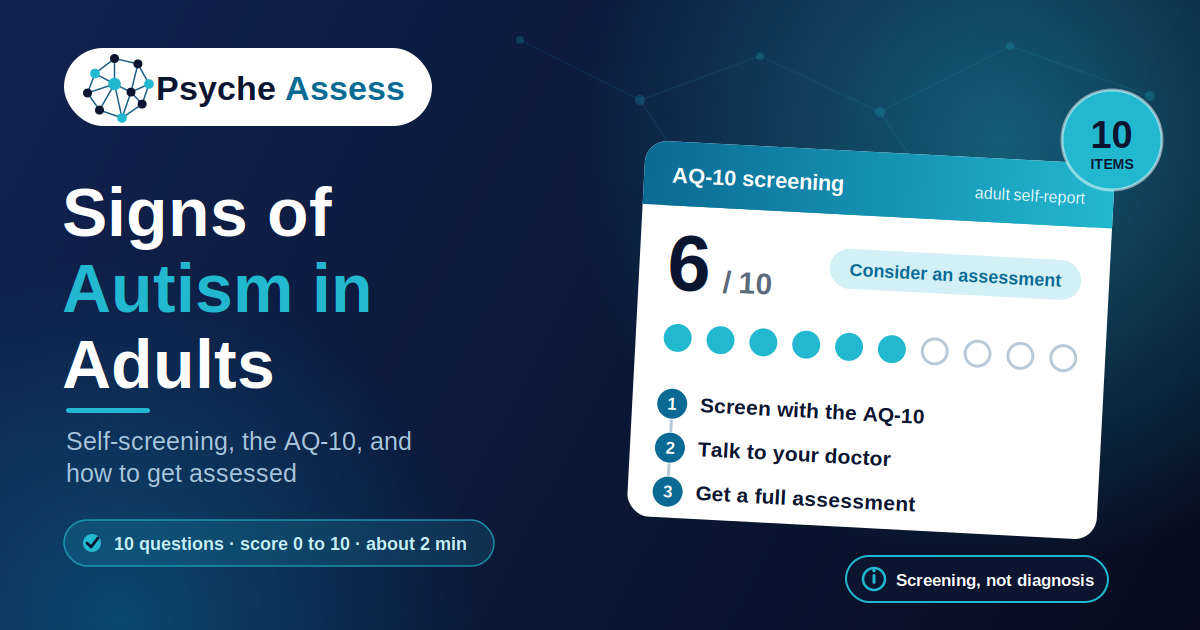
The AQ-10 is a ten-question screening tool, a short form of the Autism Spectrum Quotient developed by Simon Baron-Cohen’s team at the University of Cambridge (Allison et al., 2012). For each statement, you choose from definitely agree to definitely disagree. Each answer that points in the autism-consistent direction scores one point, giving a total from 0 to 10. It takes about two minutes and was designed mainly for adults without a learning disability. You can see the questions and scoring on our AQ-10 page.
AQ-10 score: what does 6 mean?
A score of 6 or above suggests it may be worth being referred for a fuller autism assessment, a threshold used in the UK’s NICE guideline for adults (NICE, 2012). Two cautions apply. A score below 6 doesn’t rule autism out, particularly if you mask, and a score of 6 or above doesn’t confirm it. The AQ-10 is a prompt for a conversation with a professional, nothing more.
How to Self-Screen Thoughtfully
- Take the AQ-10 and note your score.
- Write down examples from childhood and from your life now, across home, work, and social settings.
- Ask someone who knew you as a child, such as a parent or sibling, what they remember.
- Check for related conditions. The GAD-7, PHQ-9, and ASRS can show whether anxiety, low mood, or attention difficulties are also part of the picture.
- Bring everything to your doctor to support a referral.
How an Adult Autism Assessment Works
The process varies by country and clinic, but it usually includes:
- Referral. Often through a GP or primary care doctor, and sometimes by self-referral to a specialist service.
- A clinical interview about your current difficulties, strengths, sensory experiences, and interests.
- A developmental history covering childhood behavior, school, and family history.
- Structured tools and observation, such as the ADOS-2, plus questionnaires.
- Input from others, where available, such as a parent or partner.
- A check for other conditions, including anxiety, depression, and ADHD.
- Feedback and a written report with recommendations.
Assessments can take one session or several, and waiting lists are long in many places. If you choose a private assessment, check that the clinician has experience with autism in adults.
What a Diagnosis Can and Can’t Change
A diagnosis doesn’t change who you are, but it can open doors. Many people report a sense of relief and self-understanding. It can also help you request adjustments at work or university, such as a quieter workspace, written instructions, or flexible hours, access support services, and find therapy that fits better for any anxiety or depression. Some people also feel mixed emotions, and that’s normal. Many people understand themselves as autistic without a formal diagnosis, which is a valid personal choice, though a formal diagnosis is often needed to access certain services and protections.
Support While You Wait
- Reduce sensory overload where you can, and plan recovery time after demanding events
- Use routines, visual planners, and written instructions
- Talk to your employer’s HR team or your university’s disability service about adjustments
- Look for peer support groups and communities led by autistic people
- Get help for anxiety, low mood, or burnout whether or not you receive a diagnosis
Research shows autistic adults face higher rates of anxiety, depression, and suicidal thoughts. If you’re having thoughts of harming yourself, get help now. In the US, call or text 988. In the UK and Ireland, call Samaritans on 116 123. In Australia, call Lifeline on 13 11 14. Elsewhere, contact your local emergency number.
For Clinicians: Using the AQ-10 in Practice
A digital AQ-10 scores automatically, flags results at or above the referral threshold, and keeps a structured record you can attach to a referral. Many clinicians pair it with the GAD-7, PHQ-9, and ASRS to see co-occurring conditions at the same visit. Start a free trial to run these in a test practice, or read how automation compares in manual scoring vs. automated screening tools.
Frequently Asked Questions
Can an online test diagnose autism? No. A screener like the AQ-10 can suggest that a full assessment is worthwhile, but diagnosis requires a clinician.
Is the AQ-10 accurate? It’s a brief screening tool with limits, so it can miss autistic people and flag people who aren’t autistic. Treat a score of 6 or higher as a reason to seek assessment, not as an answer.
Can you develop autism as an adult? No. Autism is present from early development, but it may only be recognized in adulthood.
Can adults get an autism diagnosis? Yes. Many adults are diagnosed in their 30s, 40s, and beyond.
The Bottom Line
If the signs in this guide sound familiar, the AQ-10 is a quick, low-pressure way to see whether a fuller assessment is worth pursuing. Treat the result as a starting point: write down your examples, check for related anxiety or low mood, and talk to a doctor about a referral. Understanding how your mind works, with or without a diagnosis, can make daily life easier to plan around.
This article is for general information and isn’t medical advice or a diagnosis.
Sources
- American Psychiatric Association. Diagnostic and Statistical Manual of Mental Disorders, 5th ed. 2013.
- Allison C, Auyeung B, Baron-Cohen S. Toward brief “Red Flags” for autism screening: the Short Autism Spectrum Quotient and the Short Quantitative Checklist in 1,000 cases and 3,000 controls. J Am Acad Child Adolesc Psychiatry. 2012;51(2):202–212.
- National Institute for Health and Care Excellence. Autism spectrum disorder in adults: diagnosis and management (CG142). 2012.
- Hull L, Petrides KV, Allison C, et al. “Putting on my best normal”: social camouflaging in adults with autism spectrum conditions. J Autism Dev Disord. 2017;47(8):2519–2534.
- Lai MC, Lombardo MV, Auyeung B, Chakrabarti B, Baron-Cohen S. Sex/gender differences and autism: setting the scene for future research. J Am Acad Child Adolesc Psychiatry. 2015;54(1):11–24.