What Does Your PHQ-9 Score Mean? A Guide to Depression Severity Levels
This guide explains PHQ-9 score meaning, how the depression severity levels are defined, what the cut-off score of 10 really tells you, and what to do next. It’s written for patients, families, and clinicians alike, and it draws on the original validation research rather than guesswork.
By The Psyche Assess team
You finished a depression questionnaire and ended up with a single number. Maybe it’s 7, maybe 14, maybe 21. What now? A PHQ-9 score is easy to read once you know how the scale works, but it’s just as easy to over- or under-interpret.
A quick note before you read on: the PHQ-9 is a screening tool. It shows how many depressive symptoms you’ve had recently and how strong they are, but only a qualified clinician can diagnose depression.
What Is the PHQ-9?
The PHQ-9 (Patient Health Questionnaire-9) is a nine-question self-report measure of depression severity. Each question matches one of the nine symptoms used to diagnose major depressive disorder: low mood, loss of interest, sleep changes, fatigue, appetite changes, poor concentration, feelings of worthlessness, slowed or restless movement, and thoughts of self-harm. It was developed by Drs. Kurt Kroenke, Robert Spitzer, and Janet Williams and validated in primary care and obstetrics-gynecology clinics (Kroenke et al., 2001).
You rate how often each problem has bothered you over the last two weeks: not at all (0), several days (1), more than half the days (2), or nearly every day (3). Adding the nine answers gives a total from 0 to 27. It takes about three minutes, it’s free to use, and it’s one of the most widely used depression screening tools in the world. You can see the full question set and scoring on our PHQ-9 page.
PHQ-9 Score Interpretation: The Five Severity Levels
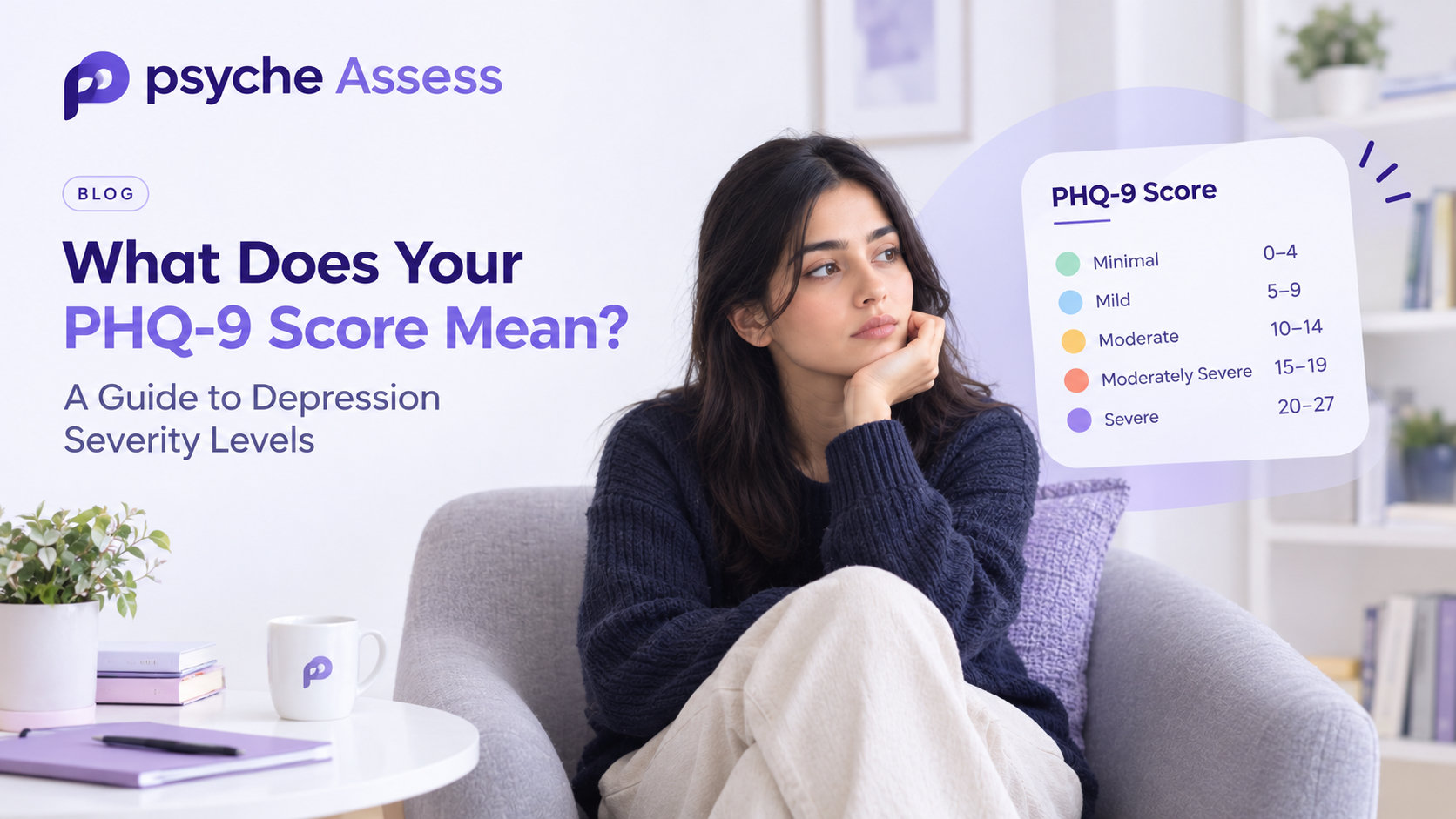
Your total score falls into one of five bands. These cut points (5, 10, 15, and 20) come from the original PHQ-9 research and are used in most clinics.
- 0–4: Minimal or no depression. Few or no symptoms. Treatment is usually not needed, though it’s worth re-screening if your mood changes.
- 5–9: Mild depression. Some symptoms are present. Clinicians often suggest watchful waiting, self-help strategies, and a repeat screening in a few weeks.
- 10–14: Moderate depression. Symptoms are likely affecting daily life. A conversation with a clinician about counseling, medication, or both is usually recommended.
- 15–19: Moderately severe depression. Symptoms are significant. Active treatment is typically advised, often combining psychotherapy with medication.
- 20–27: Severe depression. Symptoms are intense. Prompt evaluation by a mental health professional is recommended.
A score is a snapshot of the past two weeks, not a label for who you are. Two people who both score 12 can feel very different, which is why clinicians read the individual answers and ask about daily functioning, too.
What does the PHQ-9 cut-off score of 10 mean?
A score of 10 or higher is the most common threshold for a “positive” screen. In the original validation study, this cut-off had a sensitivity of 88% and a specificity of 88% for major depression (Kroenke et al., 2001). In plain terms, it correctly flagged most people who had major depression and most who didn’t. A later meta-analysis found that cut-offs between 8 and 11 perform similarly, so some clinics adjust the threshold for their population (Manea et al., 2012).
A positive screen is a reason to look closer, not a diagnosis. Some people who score 10 or above don’t meet the criteria for major depression, and some who score below 10 still deserve support.
Item 9 and the Function Question: Two Answers That Matter Beyond the Total
Item 9 asks how often you’ve had thoughts that you’d be better off dead or of hurting yourself. Any answer above “not at all” deserves a follow-up conversation, even if your total score is low. Good screening platforms flag this answer for same-day review.
If you’re having thoughts of harming yourself, please reach out now rather than waiting for an appointment. In the US, call or text 988 (Suicide & Crisis Lifeline). In the UK and Ireland, call Samaritans on 116 123. In Australia, call Lifeline on 13 11 14. Elsewhere, contact your local emergency number.
The final question isn’t scored but is just as informative: how difficult have these problems made it to work, take care of things at home, or get along with others? Functional difficulty helps your clinician judge how much support you need.
What Your PHQ-9 Score Can and Can’t Tell You
A PHQ-9 can’t tell you why you feel the way you do. Several things can raise a score without being depression, or alongside it:
- Medical causes such as thyroid problems, anemia, sleep apnea, or medication side effects
- Grief, major life stress, or burnout (see our guide to burnout vs. depression)
- Bipolar disorder, which the PHQ-9 doesn’t screen for and which needs different treatment
- Anxiety, which often occurs with depression and is better measured with the GAD-7
The reverse can happen, too. People sometimes underreport symptoms because of stigma, cultural differences in describing distress, or not wanting to worry anyone. A clinical interview fills these gaps. Large meta-analyses confirm the PHQ-9 is a useful screener, but its accuracy depends on the cut-off used and the group being screened (Levis et al., 2019).
Tracking Progress: What Counts as Improvement?
One score is a snapshot. A series of scores shows direction. When you repeat the PHQ-9 at the intervals your clinician recommends, a drop of about 5 points is generally considered a clinically meaningful improvement (Löwe et al., 2004), and a score below 5 is commonly used to define remission. A rising score is an early signal to check in with your care team rather than wait.
Clinics that use a digital platform like Psyche Assess can chart each client’s scores across sessions automatically, so a 5-point change is visible before the next appointment instead of buried in paper forms.
What to Do After You Get Your Score
- Score 0–4: Keep the habits that support your mood, and re-screen if things change.
- Score 5–9: Track your symptoms, protect sleep and routine, and talk to a clinician if symptoms last more than a couple of weeks.
- Score 10 or above: Book an appointment with a doctor, psychologist, or counselor and bring your results.
- Score 15 or above: Seek an evaluation promptly.
- Any thoughts of self-harm: Get help immediately using the contacts above.
It helps to bring a few notes to the appointment: when symptoms started, what has changed in your life, how your sleep and appetite are, and any medications you take. Ask what treatment options exist and when you should be re-screened.
PHQ-9 vs. PHQ-2 and Other Depression Screeners
The PHQ-2 uses just the first two PHQ-9 questions (low mood and loss of interest) as a one-minute first step; a score of 3 or more usually prompts the full PHQ-9. The CES-D is a longer 20-item scale often used in research, and the DASS-21 measures depression, anxiety, and stress together (see our DASS-21 explainer). The WHO-5 measures well-being rather than symptoms. Each answers a slightly different question, so the best tool depends on why you’re screening.
For Clinicians: Scoring the PHQ-9 Accurately
Adding nine numbers sounds trivial, but arithmetic slips and missed item 9 responses do happen in busy clinics. Automated scoring applies the severity bands consistently, flags any item 9 response immediately, and stores each result so trends can be exported to your EHR as structured data. We compare the two approaches in manual scoring vs. automated screening tools. To try it yourself, start a free trial and run the PHQ-9 in a test practice.
Frequently Asked Questions
Is a PHQ-9 score of 10 bad? It’s the usual threshold for a positive screen and suggests moderate symptoms worth discussing with a clinician. It isn’t a diagnosis.
Can the PHQ-9 diagnose depression? No. It’s a screening and severity tool. Diagnosis requires a clinical assessment.
How often should I retake the PHQ-9? Follow your clinician’s advice. During treatment it’s often repeated every few weeks to track change. Because it covers the past two weeks, retaking it daily isn’t useful.
Does a high score mean I need medication? Not automatically. Treatment depends on your symptoms, history, and preferences, and often includes psychotherapy, lifestyle support, or medication. It’s a decision to make together with a clinician.
The Bottom Line
Your PHQ-9 score places your recent symptoms on a five-level scale, with 10 as the common line for taking a closer look. It’s a useful starting point, not a verdict. Pair the number with how you’re actually functioning, give extra weight to item 9, and use repeat scores to see whether things are improving. If your score is 10 or higher, or you simply feel worse than a number can say, talk to a healthcare professional.
This article is for general information and isn’t medical advice or a diagnosis. If you’re in crisis, contact your local emergency services.
Sources
- Kroenke K, Spitzer RL, Williams JBW. The PHQ-9: validity of a brief depression severity measure. J Gen Intern Med. 2001;16(9):606–613.
- Manea L, Gilbody S, McMillan D. Optimal cut-off score for diagnosing depression with the Patient Health Questionnaire (PHQ-9): a meta-analysis. CMAJ. 2012;184(3):E191–E196.
- Levis B, Benedetti A, Thombs BD. Accuracy of Patient Health Questionnaire-9 (PHQ-9) for screening to detect major depression: individual participant data meta-analysis. BMJ. 2019;365:l1476.
- Löwe B, Unützer J, Callahan CM, Perkins AJ, Kroenke K. Monitoring depression treatment outcomes with the Patient Health Questionnaire-9. Med Care. 2004;42(12):1194–1201.